
Visa & entry · NIA · 2026
China 30-Day Visa-Free Policy: December 31, 2026 Deadline
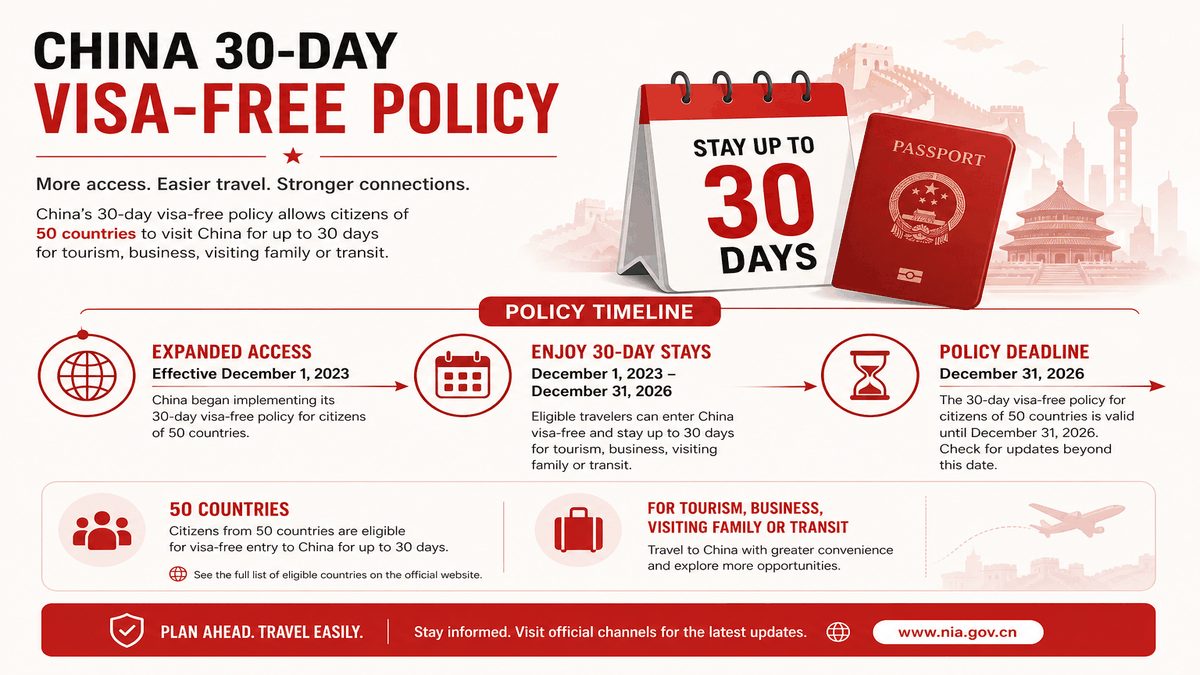
Fifty countries hold ordinary passports that qualify for 30-day unilateral visa-free entry under China’s current trial framework—including the United Kingdom and Canada from 17 February 2026. Public announcements schedule most arrangements through 31 December 2026 (Beijing time). Extension beyond that date is not confirmed at the time of writing.
Bottom line: if your passport is on the unilateral list, you can often enter mainland China for up to 30 days per entry without a consular visa—but the policy is a time-limited trial, not a permanent treaty. Book refundable fares where possible and re-check NIA guidance before non-refundable commitments, especially for trips crossing into 2027.
What the December 31, 2026 deadline means
China’s unilateral visa waiver for short stays has been rolled out in stages since late 2023. Ministry of Foreign Affairs and National Immigration Administration (NIA) statements quoted in international press describe many national arrangements as running through 24:00 on 31 December 2026, Beijing time.
That wording matters for ticketing:
- Entries before the cutoff generally rely on the policy text in force on your arrival date—not when you bought the ticket.
- China has extended similar trial programs before, but each extension required a new announcement. Treat renewal as uncertain until published.
- Trips with departures in January 2027 should not assume the 30-day waiver still applies without a fresh NIA or MFA notice.
The 50-country unilateral list (overview)
As compiled in NIA-related roundups dated 17 February 2026, the unilateral 30-day track totals 50 countries across Europe, Oceania, Asia, and the Americas. Ordinary passport holders from listed nations may enter for purposes such as tourism, business, family visits, exchanges, and transit, subject to officer review.
Representative regions (not a substitute for the live list):
- Europe: France, Germany, Italy, Spain, Netherlands, Switzerland, and numerous EU/Schengen-aligned states
- Asia-Pacific: Japan, South Korea, Singapore, Malaysia (note: Malaysia also operates under separate mutual arrangements with additional rolling limits)
- Oceania: Australia, New Zealand
- Americas: Brazil, Argentina, Chile, and—from February 2026—Canada
Full tables and footnotes: China visa-free list 2026 and which countries get 30-day visa-free entry.
United Kingdom and Canada: February 17, 2026 addition
On 17 February 2026, Chinese authorities announced that ordinary passport holders from the United Kingdom and Canada join the unilateral waiver. MFA briefing language quoted by visa-news outlets states eligible travelers may stay up to 30 days for business, tourism, visiting friends and relatives, exchanges, and transit, with the same 31 December 2026 end date unless extended.
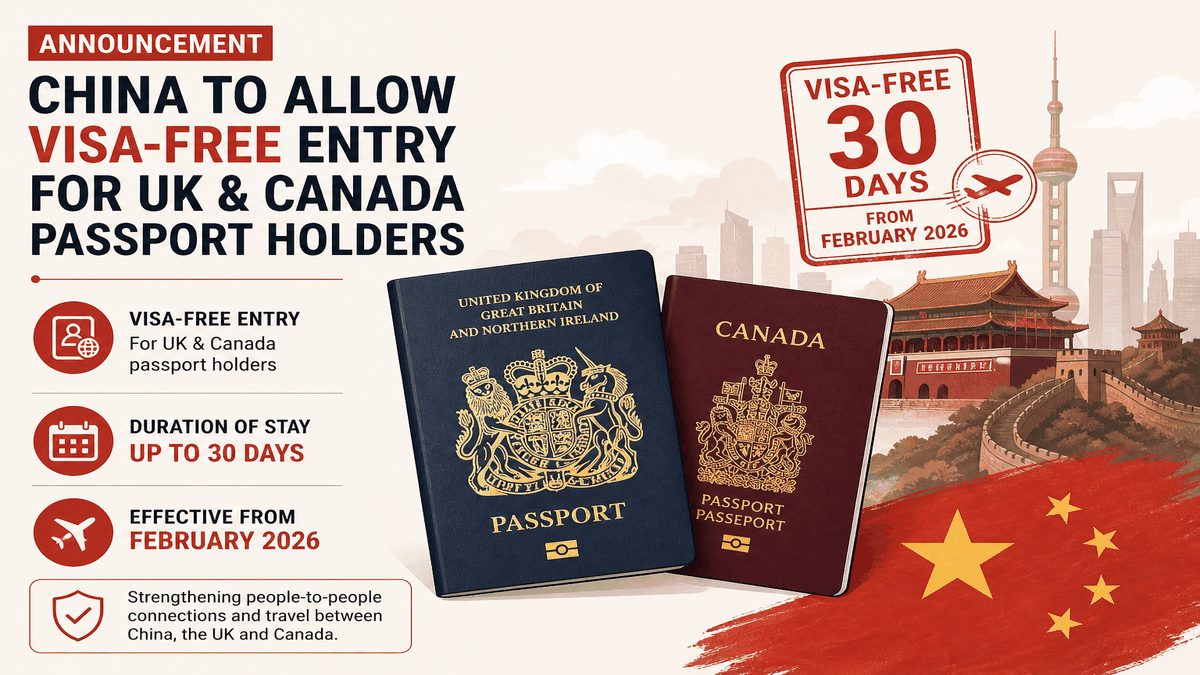
Practical shifts for British and Canadian travelers:
- Last-minute business and family trips become feasible without consular appointments—when purpose matches allowed categories.
- Paid employment and long-term study still require appropriate visas; a visa-free stamp is not a work permit.
- Hotels usually handle police registration for foreign guests; keep booking confirmations for border questions.
Allowed stays, counting days, and what is excluded
| Topic | Typical published rule | Traveler action |
|---|---|---|
| Stay length | Up to 30 days per entry for listed passports | Count from entry stamp; do not overstay |
| Purposes | Tourism, business meetings, family visits, exchanges, transit | Do not use for paid work or degree study |
| Ports | Generally any open port accepting foreigners | Match airline ticket to a legal entry airport or land crossing |
| Onward ticket | Often not required for 30-day unilateral entry (unlike transit) | Airlines may still ask—carry proof if unsure |
| Arrival card | Digital arrival card commonly required | File on NIA channels within the published window |
Step-by-step trip design: how to plan a visa-free China trip.
30-day entry vs 240-hour transit (do not mix them up)
China runs a separate 240-hour (10-day) visa-free transit policy for a different (and partially overlapping) nationality set. Transit requires a qualifying Country A → China → Country C itinerary with a confirmed onward ticket to a third country or region, and movement is bounded by transit rules.
The 30-day unilateral track is what most European, UK, Canadian, Australian, and several Asian leisure travelers use for a straight tourism entry. If you are not on the 50-country list, transit may still be your path—start at 240-hour visa-free transit and 240-hour policy guide.
Planning timeline before the deadline
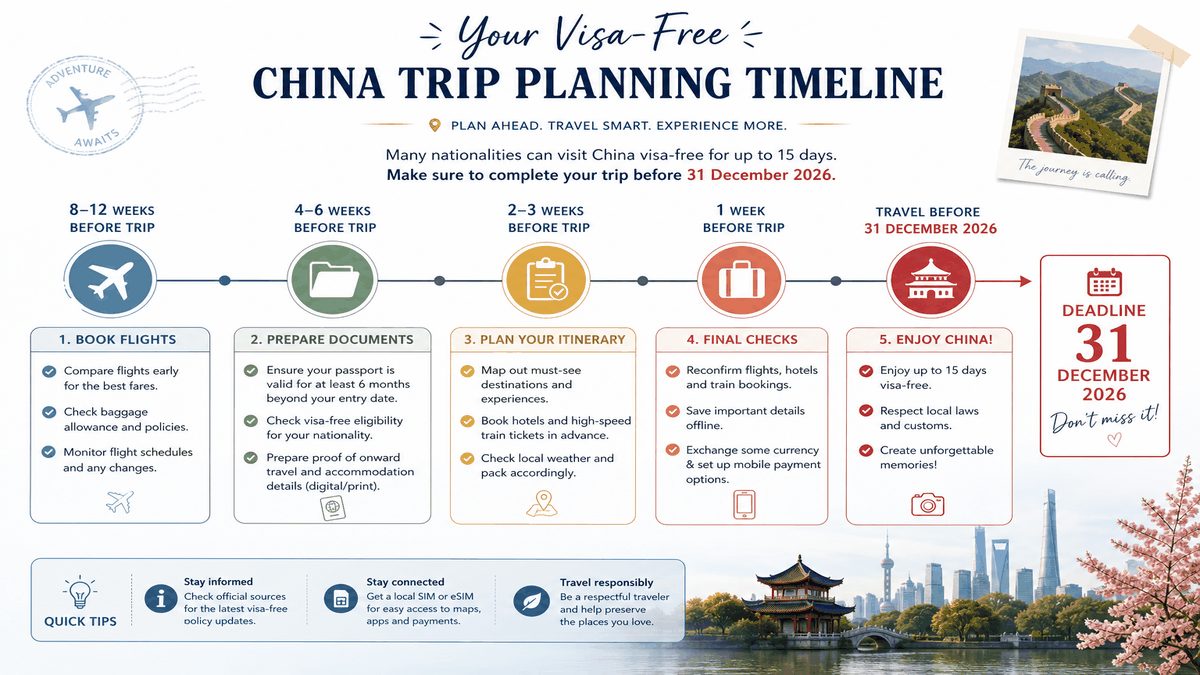
- Confirm nationality on the live list (30-day country guide).
- Book flights with change options if traveling late December 2026—policy news can drop with little warning.
- Pre-book hotels that accept foreign passports: foreigner-friendly hotels or Trip.com hotels.
- Lock rail legs for multi-city loops via Trip.com trains once dates are firm.
- Re-check NIA within two weeks of departure—lists and end dates have changed before.
FAQ
Will China extend the policy past December 31, 2026?
Unknown. Previous trial rounds were extended after new announcements, but there is no guarantee. Plan late-2026 travel with refundable bookings until an official extension is published.
I land on December 30, 2026. Can I stay 30 days into January 2027?
Entry stamps are normally counted from your arrival date, but policy text on whether the December 2026 deadline affects entries vs program existence should be confirmed on NIA notices for your nationality. If your stay would cross into 2027, read embassy guidance carefully and consider shortening the trip or obtaining a visa as backup.
How many countries are on the list?
50 under the unilateral 30-day compilation dated 17 February 2026, including the UK and Canada. Malaysia and Singapore involve additional mutual-agreement nuances—see the full country guide.
Can I work remotely on visa-free entry?
Remote work for overseas employers occupies a gray zone; paid activity inside China generally requires a work visa. Business meetings and conferences may fit “business” purposes if they match officer expectations—do not treat visa-free entry as a work permit.
Do UK and Canadian citizens still need visas for Hong Kong or Macau?
Separate systems. This article covers mainland China entry. Hong Kong and Macau maintain their own visa policies; a mainland waiver does not automatically govern those borders.
Some links on this page go to Trip.com with partner parameters. They do not change the price you see at checkout. Start China Travel may earn a commission on qualifying bookings.