China240-Hour Visa-Free Transit — Complete2026Guide
Citizens of 57 countries can transit through China for up to 240 hours (10 days) without a visa. Here’s exactly how it works, who qualifies, and how to avoid getting denied at the border.
 Peter Wilson
May 2026
18 min read
Peter Wilson
May 2026
18 min read
Trip funnel
What Is the 240-Hour Visa-Free Transit?
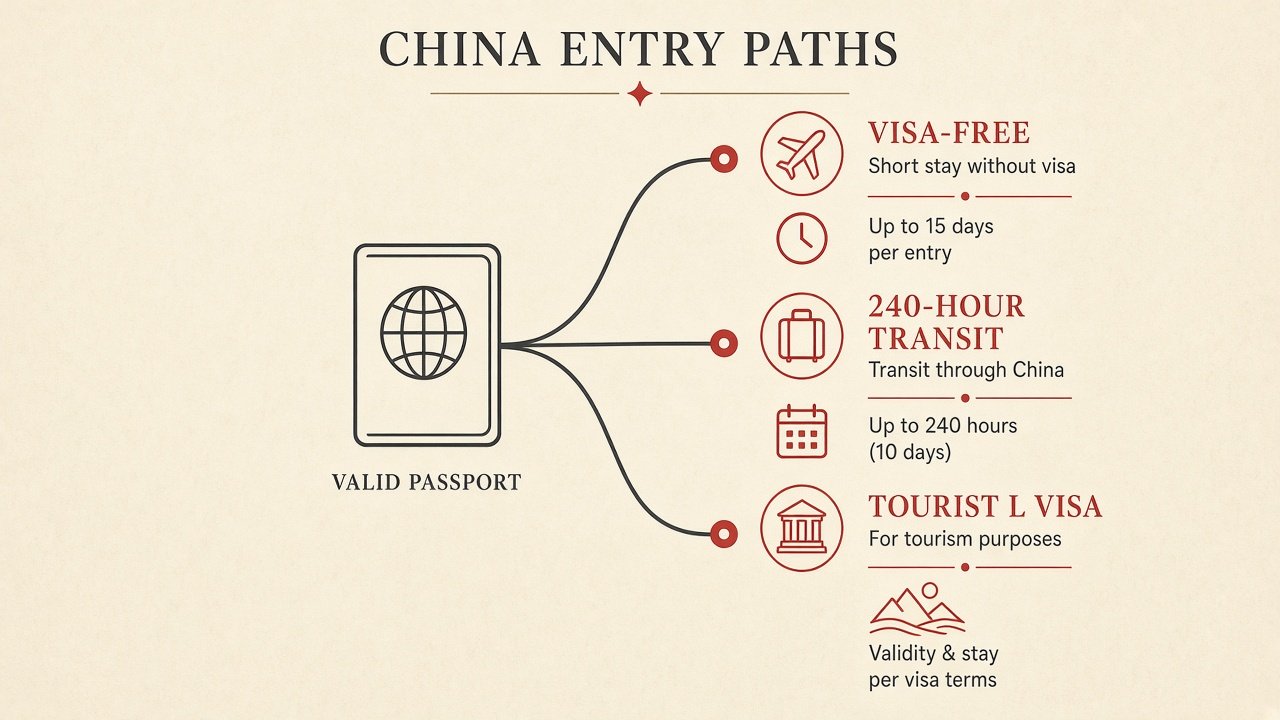
China’s 240-hour (10-day) visa-free transit policy allows citizens of 57 eligible countries to enter China without a visa when they are transiting through the country to a third destination. It’s the most generous transit visa exemption China has ever offered — and since the2024 expansion, it covers most major entry ports across the country.
The policy was originally72 hours, expanded to 144 hours in 2019, and then upgraded to 240 hours in late 2024. It’s designed to encourage short-term tourism and business visits during layovers.
Who Is This For?
- Layover travelers — flying through a Chinese hub and want to explore the city
- Short-trip planners — building a 3to 10day China trip into a larger Asia itinerary
- Business travelers — attending meetings or trade fairs without applying for a visa
- Budget travelers — avoiding a separate tourist-visa application when you qualify
Eligible Countries (Full List of 57)
As of the National Immigration Administration (NIA) English policy page (updated 20 August 2026), nationals of 57 countries may use 240-hour visa-free transit when other conditions are met. Kyrgyzstan and Vietnam were added effective that date.
Source: NIA — Visa-Free Transit Policies · NIA Announcement No. 4 of 2026. Always re-check before you fly.
Europe (40 countries)
Americas (6 countries)
Asia (9 countries)
Oceania (2 countries)
The 5 Key Rules You Must Follow
The 240-hour transit policy is generous, but it comes with strict conditions. Break any of these and you’ll be denied entry or face penalties.
You Must Have a Confirmed Onward Ticket
You need a booked and confirmed ticket (flight, train, or ferry) departing China to athird country or region within 240 hours of your arrival. “I’ll book it later” won’t work — immigration will check.
Third-Country Rule
Your departure destination must be different from the country you arrived from. Example: USA → China → Japan = valid. But USA → China → USA = not valid (unless your entry port allows same-country return — some do under the 2024 expansion, but don’t rely on it).
Stay Within the Permitted Region
Most entry ports now allow nationwide travel under the 2024 expansion. However, some land ports and smaller airports may still restrict you to specific provinces. Always confirm with immigration at your entry point.
240Hours Starts at Midnight After Arrival
The clock starts at00:00 on the day after you arrive. If you land on June 1st at 3pm, your 240 hours begin at midnight June 2nd and expire at midnight June 12th. You must depart before the deadline.
Enter and Exit Through Designated Ports
You must enter and exit through one of the designated ports (listed below). You can enter and exit through different ports — for example, fly into Shanghai Pudong and depart from Beijing Capital.
Eligible Entry & Exit Ports by Region
Since the 2024 expansion, most major airports, railway stations, and seaports across China are designated ports for the240-hour transit policy. Here are the key ones organized by region:
North China
- Beijing Capital Airport (PEK)
- Beijing Daxing Airport (PKX)
- Tianjin Binhai Airport (TSN)
- Shijiazhuang Airport (SJW)
- Shenyang Taoxian Airport (SHE)
- Dalian Zhoushuizi Airport (DLC)
- Tianjin Cruise Port
- Beijing West / South Railway Station
East China
- Shanghai Pudong Airport (PVG)
- Shanghai Hongqiao Airport (SHA)
- Nanjing Lukou Airport (NKG)
- Hangzhou Xiaoshan Airport (HGH)
- Qingdao Jiaodong Airport (TAO)
- Ningbo Lishe Airport (NGB)
- Shanghai Cruise Port
- Shanghai Railway Station
South China
- Guangzhou Baiyun Airport (CAN)
- Shenzhen Bao’an Airport (SZX)
- Xiamen Gaoqi Airport (XMN)
- Haikou Meilan Airport (HAK)
- Shenzhen Bay / Futian Port (land)
- Zhuhai Gongbei Port (land)
- Guangzhou South Railway Station
Central & West China
- Chengdu Tianfu Airport (TFU)
- Chongqing Jiangbei Airport (CKG)
- Wuhan Tianhe Airport (WUH)
- Xi’an Xianyang Airport (XIY)
- Kunming Changshui Airport (KMG)
- Changsha Huanghua Airport (CSX)
- Guilin Liangjiang Airport (KWL)
Northeast & Others
- Harbin Taiping Airport (HRB)
- Changchun Longjia Airport (CGQ)
- Hohhot Baita Airport (HET)
- Urumqi Diwopu Airport (URC)
- Suifenhe Railway Port (land)
- Heihe Port (land)
Important Note
- Since December 2024, most ports allow nationwide travel
- Some land ports may have regional restrictions
- Always confirm at immigration upon entry
- Hong Kong, Macau, and Taiwan count as “third destinations”
Step-by-Step: How to Use the240-Hour Transit
Here’s exactly what to do before, during, and after your arrival:
Before Your Trip
- Confirm your eligibility — check the country list above
- Book your onward ticket — you need a confirmed flight, train, or ferry to a third country departing within 240 hours
- Choose your entry port — pick from the designated ports above
- Fill out the arrival card — available on the plane or at immigration
- Prepare your documents:
- Valid passport (6+ months validity recommended)
- Confirmed onward ticket (printed or on phone)
- Hotel booking confirmation
At Immigration
- Go to the “Transit Without Visa” lane — look for signs saying “24/ 144 / 240 Hour Transit” or ask staff
- Present your passport, arrival card, and onward ticket
- Get your temporary entry stamp — the officer will stamp your passport with the entry date and permitted stay duration
- Note your deadline — the stamp will show when you must depart by
During Your Stay
- Register at your hotel — hotels handle police registration automatically
- If staying with friends or Airbnb — you must register at the local police station within 24 hours
- Travel freely — most ports now allow nationwide travel
- Set up digital essentials — see ourDigital Survival Kit
Landing in China Soon?
Get your VPN, eSIM, and payment apps set up before you arrive.
Open Digital Survival Kit →240-Hour Transit vs. 30-Day Visa-Free: Which Do You Need?
Since China expanded its visa-free policies in 2024 and 2025, many travelers are confused about which policy applies to them. Here’s a clear comparison:
| Feature | 240-Hour Transit | 30-Day Visa-Free |
|---|---|---|
| Max Stay | 240 hours (10 days) | 30 days |
| Eligible Countries | 57 countries | Varies (38+ countries as of 2026) |
| Onward Ticket Required? | Yes — to a third country | No |
| Third-Country Rule? | Yes | No |
| Entry Restrictions? | Designated ports only | Any international port |
| Travel Area | Nationwide (most ports) | Nationwide |
| Cost | Free | Free |
| Best For | Layovers, short transit trips | Dedicated China trips |
Check the30-day list: 30-Day Visa-Free Countries →
Pro Tips & Common Mistakes
Do This
- Print your onward ticket — phone screens can fail, and immigration officers sometimes prefer paper
- Arrive early at the airport for departure — give yourself 3+ hours for international flights from Chinese airports
- Book aforeigner-friendly hotel — not all hotels can accept foreign guests; use Trip.com and filter accordingly
- Keep your passport on you at all times — police spot-checks happen, especially in transit areas
- Screenshot your entry stamp — in case you need to reference your deadline
- Use Hong Kong or Macau as your “third destination” — they count as separate regions, making round-trip routing easier
Don’t Do This
- Don’t arrive without an onward ticket — you will be denied entry, no exceptions
- Don’t assume you can extend — the 240 hours is a hard limit; extensions are extremely rare
- Don’t confuse this with the 30-day policy — different rules, different country lists
- Don’t forget hotel registration — it’s legally required within 24 hours of check-in
- Don’t book a return to the same country — the third-country rule is enforced at check-in and immigration
- Don’t rely on airport Wi-Fi for documents — download everything offline before landing
Sample Itinerary: 240-Hour Transit Through Shanghai
Here’s a realistic 7-day transit itinerary using the 240-hour policy:
- Day 1: Arrive Shanghai Pudong (PVG), check into hotel, set up Alipay and VPN
- Day 2 to 3: Explore Shanghai — The Bund, Yu Garden, French Concession, Nanjing Road
- Day 4: High-speed train to Hangzhou (45 min) — West Lake, Lingyin Temple
- Day 5: Train to Suzhou (1.5 hours) — classical gardens, Pingjiang Road
- Day 6: Return to Shanghai — Pudong skyline, shopping
- Day 7: Depart Shanghai to Tokyo, Seoul, or Bangkok (third country)
Need help planning? See our complete visa-free trip planning guide and book train tickets for city-hopping.
Ready to Book Your Transit Trip?
Find flights, foreigner-friendly hotels, and high-speed train tickets.
Book Your Trip →How this page was built
Editorial update (not a live airport test). Country count (57), ports (65), and the Kyrgyzstan/Vietnam addition follow the English NIA pages linked above (posted/updated 20 August 2026). Port-stay maps and airline check-in rules can still differ in practice—confirm with your carrier and the inspection desk.
Frequently Asked Questions
Can I enter and exit through different cities?
Does Hong Kong or Macau count as a “third country”?
What if my flight is delayed and I overstay?
Can I use this policy multiple times?
Do I need travel insurance?
Can I take domestic flights within China during my transit?
What documents do I need to show at immigration?
Is the 240-hour policy the same as “visa-free entry”?
Visa & Entry Guides
Can Americans Visit China in 2026? Visa Paths & Booking
US travelers · Planning order · 2026 Can Americans Visit China in 2026? Yes. Tourism is open for US passport…
Can Americans Travel to China Without a Visa? (2026)
Visa & entry · US passports · 2026 Can Americans Travel to China Without a Visa in 2026? Short answer:…
China Customs for Foreigners 2026: Cash Limits & Red Channel
Airport arrival · Customs · Cash declaration China Customs for Foreigners 2026: Cash Limits & Red Channel This is airport…
Vietnam Hainan Visa-Free China 2026: 30-Day Entry & 240-Hour Transit Guide
Visa policy · Vietnam · Hainan · 2026 Vietnam Citizens: Hainan 30-Day & 240-Hour China Entry (2026) From 20 August…
China 30-Day Visa-Free Policy: December 31, 2026 Deadline & What Happens Next
Visa & entry · NIA · 2026 China 30-Day Visa-Free Policy: December 31, 2026 Deadline Fifty countries hold ordinary passports…
China Shopping Tax Refund 2026: Instant Refund & What Changed July 1
Shopping · STA policy · 2026 China Shopping Tax Refund (2026): Instant Refund & July 1 Changes China’s upgraded departure…