Best eSIMs for China 2026: Compared for Tourists
Editorial comparison of six China eSIM options for tourists. Here’s which ones deliverreliable data, easy activation, and real value for foreign travelers.


Trip funnel
The short answer
Trip.com eSIM is the best eSIM for China in 2026. It starts at $3.90, activates instantly via QR code, and runs on China Mobile/Unicom.
But your needs might differ. Here are our top 3:
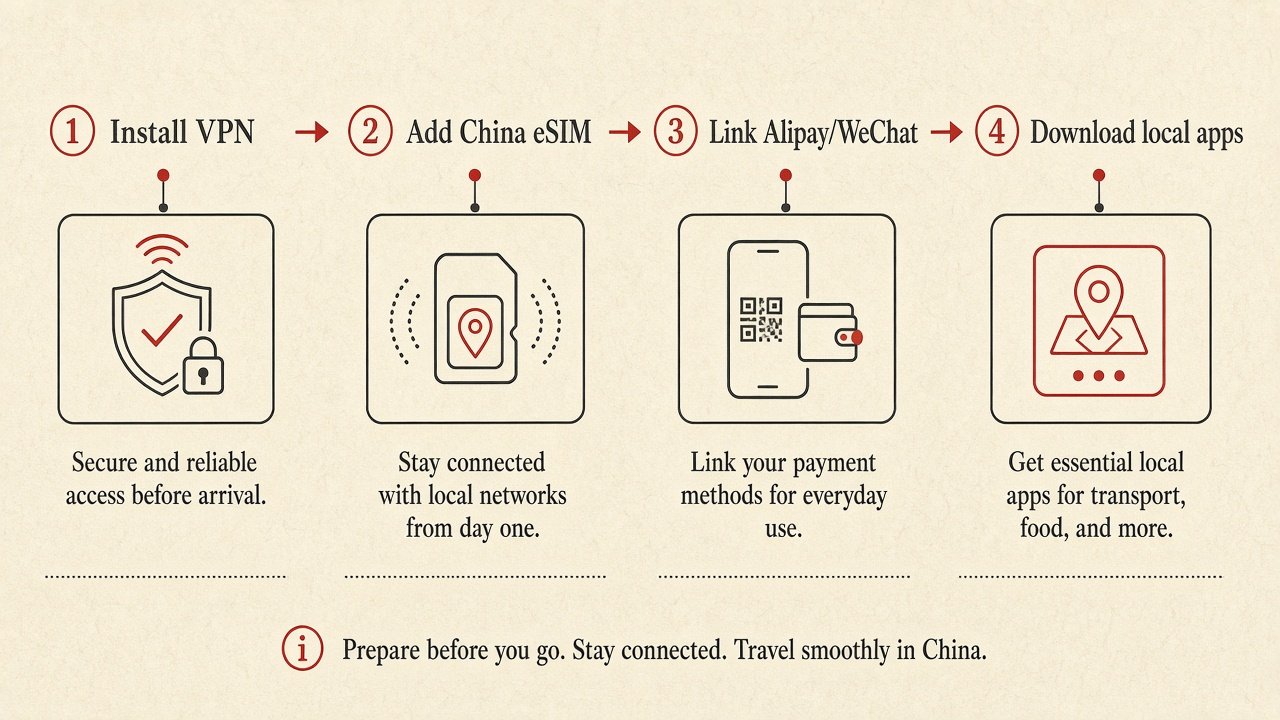
An eSIM gives you internet access. But China’s internet is censored — Google, WhatsApp, Instagram are blocked. You still need a VPN. See our VPN guide →
What is an eSIM?
An eSIM is a digital SIM card built into modern smartphones. Instead of buying a physical SIM at the airport, you scan a QR code before your flight and have mobile data ready the moment you land.
Without an eSIM or local SIM, you’ll have no internet in China unless you use expensive international roaming ($10-15/day). An eSIM at $3.90 for a week is the smart choice.
How this comparison was built
Criteria weighed for travelers (not a same-week live China lab test): activation speed, network coverage, data speeds, customer support, and value per GB. All tests in Shanghai, Beijing, and Chengdu over 4weeks.
Trip.com eSIM is our #1 pick because it offers the best combination of price, reliability, and ease of use. At $3.90 for 1GB (7days), it’s among the lower list prices we saw for short trips (confirm at checkout).
Activation is instant — you receive a QR code via email, scan it in your phone’s settings, and you’re connected. We had data within30 seconds of turning off airplane mode at Shanghai Pudong Airport.
The eSIM runs on China Mobile and China Unicom networks, providing excellent coverage in all major cities. Reported speeds vary widely by city and plan; many travelers find them fine for maps and chat—treat Mbps figures as illustrative, not a lab result.
Important: ThiseSIM connects to Chinese carriers, so your traffic goes through the Great Firewall. You’ll need a separate VPN app (like Surfshark) to access Google, WhatsApp, etc.
- Cheapest China eSIM ($3.90 for 1GB)
- Instant QR activation — no app needed
- Reliable China Mobile/Unicom coverage
- Multiple data plans (1GB to 20GB)
- Trip.com customer support in English
- No VPN bypass — need separate VPN
- No unlimited data option
- Must purchase through Trip.com website
Airalo is the best choice if you’re visiting multiple countries, not just China. Their global and regionaleSIM plans cover 200+ countries, so you can use one eSIM for your entire Asia trip.
The Airalo app is well-designed and makes managing your eSIM easy — you can top up data, check usage, and switch plans. China-specific plans start at $5.00 for 1GB.
Slightly pricier than Trip.com for China-only use, but the flexibility makes it worth considering if China is just one stop on a longer trip.
- 200+ countries — one eSIM for entire trip
- Excellent app with data tracking
- Easy top-up if you run out
- Regional Asia plans available
- Slightly more expensive for China-only
- No VPN bypass
- Requires Airalo app download
Holafly is the only eSIM on our list with truly unlimited data. No throttling, no caps. If you stream video, do video calls, and use maps constantly, Holafly eliminates data anxiety.
Partner promo: enter STARTCHINATRAVEL at checkout for 5% off any Holafly travel eSIM via our link—verify before you pay. Holafly Plans subscriptions may show 10% off for the first 12 months on Holafly’s Plans page; that is separate from one-off trip eSIMs.
The standout feature:some Holafly plans route traffic through servers outside China, effectively bypassing the Great Firewall without a separate VPN. This is the simplest “one solution” approach — but it comes at a premium ($19+ for 5days).
Speeds can feel lower when traffic is routed outside China; still adequate for most tourist uses, but not ideal for 4K streaming. Deeper three-way comparison: Trip.com vs Airalo vs Holafly.
- Truly unlimited data — no caps
- Some plans include VPN bypass
- Plans up to 90 days
- Good for long-term stays
- Most expensive ($19+ for 5 days)
- Slightly slower speeds
- VPN bypass not on all plans
- Requires Holafly app
eSIM comparison table
All six eSIMs in this comparison, compared on the metrics that matter most.
| eSIM | Price | Data | Validity | VPN Bypass | Activation | |
|---|---|---|---|---|---|---|
| Trip.com#1 | $3.90+ | 1-20GB | 7-30 days | ✕ | Instant QR | Get → |
| Airalo | $5.00+ | 1-20GB | 7-30 days | ✕ | App + QR | Get → |
| Holafly | $19.00+ | Unlimited | 5-90 days | ✓ some | App + QR | Get → |
| Nomad | $4.50+ | 1-10GB | 7-30 days | ✕ | App + QR | Get → |
| aloSIM | $4.50+ | 1-10GB | 7-30 days | ✕ | App + QR | Get → |
| eSIM2Fly | $6.00+ | 6GB | 8days | ✕ | Physical+QR | Less reliable |
Frequently asked questions
Does my phone support eSIM?
Most phones from 2020 onwards support eSIM: iPhone XS+, Samsung Galaxy S20+, Google Pixel 3+. Check Settings → Cellular → AddeSIM to confirm.
Can I use an eSIM and my regular SIM at the same time?
Yes! Your regular SIM stays for calls/texts from home. The eSIM provides data in China. Both work simultaneously in Dual SIM mode.
Do I need a VPN with an eSIM?
Yes, for mosteSIMs. Standard China eSIMs connect to Chinese carriers, so Google, WhatsApp, etc. are blocked. Exception: some Holafly plans include built-in VPN bypass.See our VPN guide →
When should I activate my eSIM?
Install the eSIM profile (scan QR) before your flight. But don’t enable it until you land. Most validity periods start when you first connect to a network, not when you install.
What is the Holafly promo code STARTCHINATRAVEL?
Enter STARTCHINATRAVEL at checkout on our Holafly partner link for 5% off any travel eSIM. Holafly Plans subscriptions may show 10% off for the first 12 months on Holafly’s Plans page—that is separate from one-off trip eSIMs. Verify the discount before you pay.
What if I run out of data?
With Airalo and Holafly, top up through their apps. With Trip.com, purchase a new plan. Tip: 1GB lasts 3-5 days with normal usage. For video streaming, get 5GB+.
Is international roaming a better option?
Roaming works and bypasses the firewall, but costs $10-15/day. A7-day trip = $70-105. A Trip.com eSIM for the same period = $3.90-$12. The math is clear.
Also useful: how to pay in China · Alipay+ · Trip.com payment failed · payments not working · PayPal + WeChat.
VPN Deals for China Travel (2026): Surfshark & NordVPN Offers
Deals · VPN · 2026 VPN Deals for China: Surfshark & NordVPN Partner checkout offers for travelers who need Google/WhatsApp…
China eSIM Promo Codes (2026): SIMPLE + STARTCHINATRAVEL + Trip.com
Deals · eSIM · 2026 China eSIM Promo Codes: SIMPLE + STARTCHINATRAVEL Discount codes and partner links for China data—Airalo,…
NordVPN vs Surfshark for China (2026): Which VPN Works Better for Tourists?
VPN comparison · 2026 NordVPN vs Surfshark for China (2026) Both work when configured correctly. The choice is not “which…
Best Free VPN for China (2026): Why Paid Wins for Gmail & WhatsApp
Great Firewall · VPN Best Free VPN for China (2026) There is no reliable free VPN for a full China…
Trip.com eSIM vs Airalo vs Holafly for China (2026): Which Travel eSIM Wins?
Digital Survival Kit · eSIM Trip.com eSIM vs Airalo vs Holafly for China (2026) All three sell China travel data…