
Planning / Weather
Best Month to Visit China for Good Weather: The 2026 Insider Guide
October 8–31 is the most reliable sweet spot for the classic Beijing–Xi’an–Shanghai route plus Guilin: cooler air in the north, comfortable highs in the east, better odds on visibility, and crowds that drop after Golden Week.
 By Peter Wilson · StartChinaTravel · Updated for 2026
Mid-July in Beijing often means thick humidity and hazy horizons. Late October in Shanghai more often delivers a sharp skyline against clear, dry air. Weather varies wildly by latitude and monsoon patterns, but crowd timing matters as much as temperature—domestic holidays can turn a “pleasant” forecast into a miserable queue experience.
For most first-time visitors on the standard triangle plus Guilin, prioritize 8 October–31 October 2026. If autumn is impossible, target late April through mid-May, while steering clear of Labour Day (1–5 May).
Free trip planner
Match your month to cities and a booking checklist
Pick departure month and cities on our planner—route order, holiday warnings, VPN, eSIM, trains, and timed tickets. Progress saves on your device only.
Where to go each month in China (2026)
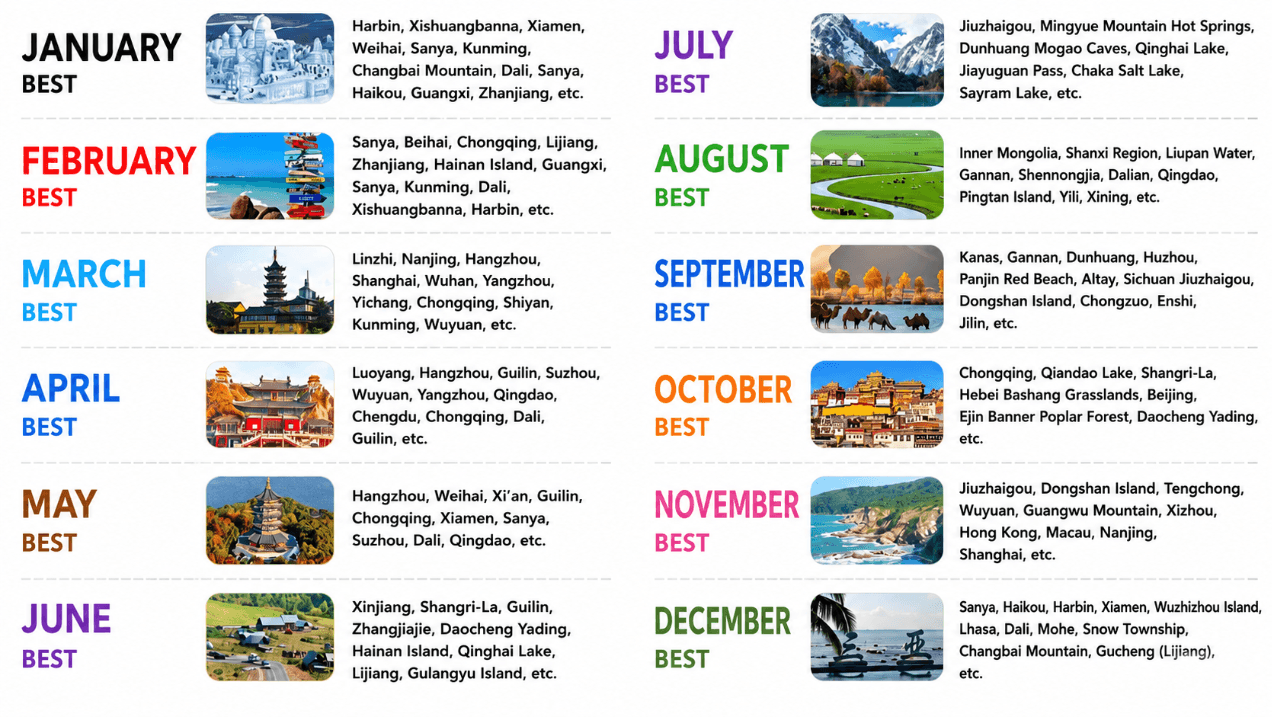
The chart at the top is a practical destination shortlist by calendar month—not a guarantee of sunshine every day. Use it to pick a region theme first (ice, blossoms, grassland, desert, coast), then check holidays and train release windows before you buy non-refundable flights.
January
Harbin · Xishuangbanna · Xiamen · Weihai · Sanya · Kunming · Changbai Mountain · Dali · Haikou · Guangxi · Zhanjiang
Why: Split season—ice and snow sculpture in the northeast (Harbin, Changbai), tropical escape on Hainan and Xishuangbanna. Crowd alert: Chinese New Year (often late Jan–Feb) spikes prices nationwide; book trains and hotels early or avoid the peak block.
February
Zhuhai · Chongqing · Lijiang · Zhanjiang · Weizhou Island · Guangxi · Sanya · Kunming · Dali · Xishuangbanna · Harbin
Why: Still strong for warm-south beach and old-town pacing; Harbin ice lingers early in the month. Pair with our Chongqing guide if you want hotpot cities without northern cold.
March
Nyingchi (Tibet peach blossoms) · Nanjing · Hangzhou · Shanghai · Wuhan · Yangzhou · Yichang · Chongqing · Shiyan · Kunming · Wuyuan (rapeseed flowers)
Why: East China blossom and lake season; Wuyuan and Nyingchi are photography peaks. Watch: North China can be windy with sandstorm risk—pack a mask if you include Beijing.
April
Luoyang (peony) · Hangzhou · Guilin · Suzhou · Wuyuan · Yangzhou · Qingdao · Chengdu · Chongqing · Dali
Why: Mild walking weather on many classic routes; peony festivals and Jiangnan water towns shine. Skip window: Labour Day (1–5 May) starts the next price surge—see 2026 holidays.
May
Hangzhou · Weihai · Xi’an · Guilin · Chongqing · Xiamen · Sanya · Suzhou · Dali · Qingdao
Why: Runner-up spring corridor for the golden triangle plus coast—comfortable before summer humidity. Avoid 1–5 May Labour Day unless you accept sold-out high-speed rail.
June
Xinjiang · Shangri-La · Guilin · Zhangjiajie · Daocheng Yading · Weizhou Island · Qinghai Lake · Lijiang · Gulangyu (Xiamen)
Why: Highlands and west open up; karst and avatar mountains before peak summer heat. South and east begin monsoon stress—carry rain gear for Guilin and the Yangtze Delta.
July
Jiuzhaigou · Dunhuang (Mingsha Mountain / Crescent Lake) · Mogao Caves · Qinghai Lake · Jiayuguan · Chaka Salt Lake · Sayram Lake
Why: Alpine lakes and Silk Road desert routes at their summer access window. Trade-off: Domestic school holiday crowds and hot basins (Chongqing, Shanghai) if you mix east with west on one ticket.
August
Inner Mongolia · Western Sichuan (Chuanxi) · Liupanshui · Gannan · Shennongjia · Dalian · Qingdao · Pingtan Island · Yili · Xining
Why: Grasslands, plateau pastures, and cool-leaning coast cities when lowland megacities boil. Typhoon risk rises on southern coasts—build buffer days for flights.
September
Kanas · Gannan · Dunhuang · Huzhou · Panjin Red Beach · Altay · Jiuzhaigou · Dongshan Island · Chongzuo · Enshi · Jilin
Why: Early autumn colour in the north and west; comfortable sightseeing before National Day. Coastal typhoon season still possible early in the month.
October
Chongqing · Qiandao Lake · Shangri-La · Bashang Grassland · Beijing · Ejina Poplar Forest · Daocheng Yading
Why: Flagship month for foliage and clear northern air—but only after 7 October for manageable crowds (see late October window). Forbidden City tickets still need the 7-day release habit.
November
Jiuzhaigou · Dongshan Island · Tengchong · Wuyuan · Guangwu Mountain · Zheduo Mountain · Fragrant Hills (Beijing) · Hong Kong · Macau · Nanjing · Shanghai
Why: Late autumn hikes and ginkgo/red-leaf city parks; mild south coast before winter. Hong Kong/Macau are separate entry rules from mainland—verify visas for each leg.
December
Sanya · Haikou · Harbin · Xiamen · Wusong Island · Lhasa (winter permits/policy) · Dali · Mohe · China Snow Town · Changbai Mountain · glacier parks
Why: Twin theme again—tropical Hainan vs arctic-edge northeast. Tibet and high passes need extra permit planning in winter; check live policy before booking.
First-time triangle (Beijing–Xi’an–Shanghai + Guilin): The month chart is nationwide; for that specific loop our default remains 8–31 October or late April–mid-May—details in the matrix below. Shorter trip? See 7-day Beijing + Shanghai itinerary.
Why late October is the default pick
China spans Siberian-edge winters to tropical coastlines, so no single month is “perfect” nationwide. For the Golden Triangle (Beijing, Xi’an, Shanghai) plus Guilin, the post–National Day window lines up unusually well:
- Northern clarity: Humidity in Beijing and Xi’an eases by mid-October. Seasonal airflow often beats winter stagnation and spring dust risk for day-to-day comfort.
- Eastern comfort: Shanghai and Guilin typically land in a manageable band—often roughly 20–25 °C (68–77 °F) for daytime highs, with less oppressive stickiness than summer.
- Visual payoff: Autumn colour frames the Great Wall; hazy summer greens give way to reds and golds on many northern ridges.
1–7 October 2026 is National Day “Golden Week.” Major sights clog, trains sell out, and hotel rates spike. Waiting until 8 October usually brings lighter crowds and softer prices—without giving up peak autumn conditions.
When you are ready to lock dates, run a quick price sweep on Trip.com flights and filter hotels with flexible cancellation on Trip.com hotels.
The spring alternative: late April to mid-May
If October is out, this is the next practical window for flower colour and mild temperatures across many tourist corridors.
- Pros: Blossoms and greenery; generally pleasant walking weather in both north and south.
- Cons: Higher rain probability in the south than in October; the north can feel windy and changeable day to day.
For hotel filters that reduce “foreigner policy” surprises, pair spring timing with our foreigner-friendly hotel booking checklist.
2026 weather and crowd matrix (Beijing–Xi’an–Shanghai route)
Use this table when you are on the classic international triangle—not for the specialty months in the chart above (Harbin ice, Xinjiang, Ejina poplars, etc.).
| Month | North China temp (ref.) | Rain trend | Crowds | Verdict |
|---|---|---|---|---|
| Jan–Feb | −5 to 5 °C (23–41 °F) | Dry; snow possible | Extreme peak (CNY) | Avoid CNY |
| Mar | 5–15 °C (41–59 °F) | Dry; windy | Low–moderate | Sandstorm risk |
| Apr–May | 15–25 °C (59–77 °F) | Moderate rain (south) | Moderate | Good Skip 1–5 May |
| Jun–Aug | 25–35+ °C (77–95+ °F) | Monsoon / humid | High (school holiday) | Hot & busy |
| Sep | 20–28 °C (68–82 °F) | Moderate | Moderate | Decent Typhoon coast |
| Oct 1–7 | 15–25 °C (59–77 °F) | Often dry | Extreme peak | Avoid Golden Week |
| Oct 8–31 | ~10–20 °C (50–68 °F) north | Lower rain | Moderate | Best window |
| Nov–Dec | 0–10 °C (32–50 °F) north | Very dry | Low | Cold but calm |
Regional reality check for 2026
“China” is too large for one forecast. Match your route to the zone below, then anchor bookings on Trip.com once dates are firm.
North China (Beijing, Xi’an)
Sweet spot: September through early November for many first-timer itineraries.
Winters are dry and bitter; summers are hot. Episodic air-quality swings still happen—October usually offers more comfortable outdoor hours than stagnant winter weeks.
East China (Shanghai, Suzhou, Hangzhou)
Sweet spot: Late October into mid-November for mild days and less summer steam.
Meiyu (“Plum Rains”): Mid-June through early July brings persistent drizzle and high humidity in the Yangtze Delta—many visitors find Shanghai’s wet heat harder than Beijing’s dry summer spike.
South China (Guilin, Hong Kong, Guangdong)
Sweet spot: November–December for many leisure routes—warm enough in the south, less typhoon drama than midsummer.
Typhoon season: Coastal flights face higher delay risk July–September. If you are rafting the Li River, heavy May–June rains can raise water levels and trigger temporary safety closures—watch local notices and keep attraction tickets on Klook flexible where possible.
West and highlands (Chengdu, Chongqing, Tibet)
Chengdu / Chongqing basin: Often grey or foggy; spring and autumn feel kinder than midsummer stickiness. See also our Chengdu & Chongqing hub for pacing.
Tibet and high elevations: June–September is the common trekking window when passes are less hostile; October can turn sharply cold fast even when skies are clearer.
When “bad” weather actually helps the trip
Forecasts are tools, not the whole story. A little inconvenience can upgrade photos and atmosphere—if you pack for it.
- Yellow Mountain (Huangshan): Bluebird days can look flat; many photographers chase mist and “seas of cloud” after rain or in humid lifts of air.
- Harbin ice festival: You want serious cold—roughly −20 °C in January–February—so sculptures stay solid.
- Water towns (Suzhou): A light drizzle in April adds an atmosphere to the canals that bright sunshine lacks.

In regions like Jiangnan, a veil of light rain can read more “classical scroll painting” than harsh midday sun—just keep non-slip shoes for stone bridges.
2026 holiday windows that punish availability
Dates below follow usual public-holiday patterns; confirm final announcements on official sources before you buy non-refundable inventory. Our 2026 China festival calendar tracks strategic booking angles.
- Chinese New Year: ~15–23 February 2026 (projected peak travel).
- Labour Day: 1–5 May 2026.
- National Day Golden Week: 1–7 October 2026.
High-speed rail inventory vanishes fast around holidays. Tickets commonly open 15 days ahead at release—set an alarm for 05:00 China Standard Time on the drop day if your trip touches a peak window, and hold seats early via Trip.com China trains.
Logistics that matter as much as the forecast
Connectivity (eSIM and backup VPN)
Many travelers now prefer a roaming eSIM that routes data through an overseas carrier profile—often smoother for maps and messaging than juggling VPN toggles on hotel Wi‑Fi alone. You remain responsible for complying with local laws and carrier terms.
Visa policy (verify before tickets)
Unilateral 30-day visa-free arrangements for several European passports have been in flux—policies can change with little runway. Cross-check the latest National Immigration Administration guidance and our 2026 visa-free country list before you pay for long-haul flights.
Payments: digital-first, card-in-app—not at the terminal
Download Alipay and/or WeChat before departure and link a supported international card. Step-by-step help lives in our Alipay guide and WeChat Pay setup.
The Reality: Mastercard and Visa cards are now widely accepted inside Alipay and WeChat Pay, but physical cards are still rarely used at point-of-sale terminals. Do not rely on swiping your card.

Assume small vendors, bike shares, and many city services want in-app QR, not chip-and-PIN. Carry a little cash for edge cases, but build your default around mobile pay.
If October is the plan, book before the wave returns
Autumn seats into Beijing and Shanghai fill early once September prices start moving. Lock flights first, then hotels with sane cancellation terms, then time-slot attractions that cap daily entries.
Sites such as the Terracotta Army enforce strict daily caps—buy timed tickets on Klook as soon as your date is fixed.
Takeaways
Month map: Use the January–December chart at the top to match trip type (ice, coast, Silk Road, karst)—then narrow dates around holidays.
Primary pick (classic route): 8–31 October 2026 for weather, colour, and post–Golden Week breathing room on Beijing–Xi’an–Shanghai + Guilin.
Runner-up: Late April–mid-May for blossoms—pack a compact umbrella for the south.
Hard skips: Golden Week (1–7 October), Labour Day block, and Chinese New Year unless you are deliberately chasing festival culture and accept the operational tax.
FAQ: best time to visit China in 2026
Is October the best month overall?
For the Beijing–Xi’an–Shanghai triangle plus Guilin, yes—especially 8–31 October after National Day. Tibet, tropical Hainan, and Harbin winter trips follow different calendars.
When is the rainy season?
South and east coasts see the heaviest monsoon influence June–August. The Yangtze Delta adds Meiyu drizzle around mid-June–early July.
What is the worst window for a typical holiday?
Chinese New Year, Golden Week, and late July–August combine peak domestic travel with heat or rain stress—fine if you plan around it, punishing if you do not.
Should I travel during Golden Week?
Only with a tolerance for surged pricing, sold-out trains, and hour-long queues. Most international visitors should avoid 1–7 October unless the trip is explicitly designed around festival energy.
Do I still need a VPN in 2026?
Western webmail and social apps remain unreliable on local networks. Many travelers pair an eSIM roaming profile with a VPN for hotel Wi‑Fi—test before you depend on either.
Is November too cold?
Beijing turns crisp and jacket weather; Hong Kong and Guangzhou often stay mild. Pack layers rather than assuming one coat weight for the whole country.
Does the month-by-month chart replace the October advice?
No. The chart helps you pick a theme and region (ice, blossoms, desert, grassland). If your trip is the standard Beijing–Xi’an–Shanghai loop, still prioritize 8–31 October or late April–mid-May for weather and crowds on that corridor.
StartChinaTravel earns commissions from some links on this page (including Trip.com, Klook, eSIM, and VPN partners) at no extra cost to you. See Affiliate disclosure and How we test.