Policy update · NIA · 20 Aug 2026
Vietnam & Kyrgyzstan Join China’s 240-Hour Visa-Free Transit
From 20 August 2026, ordinary passport holders from Vietnam and Kyrgyzstan can use China’s 240-hour visa-free transit and a separate 30-day Hainan entry option. Here is what changed, who qualifies, and how to plan a legal A→China→B route.
Bottom line: Vietnamese and Kyrgyz citizens with confirmed onward tickets to a third country or region can transit mainland China for up to 240 hours (10 days) without a visa, or enter Hainan only for up to 30 days. Work, study, and news reporting still need a visa in advance.
What changed on 20 August 2026
Before this date, Vietnam and Kyrgyzstan were not on the published 240-hour country list. The August update is a country-list expansion, not a change to the 240-hour clock itself.
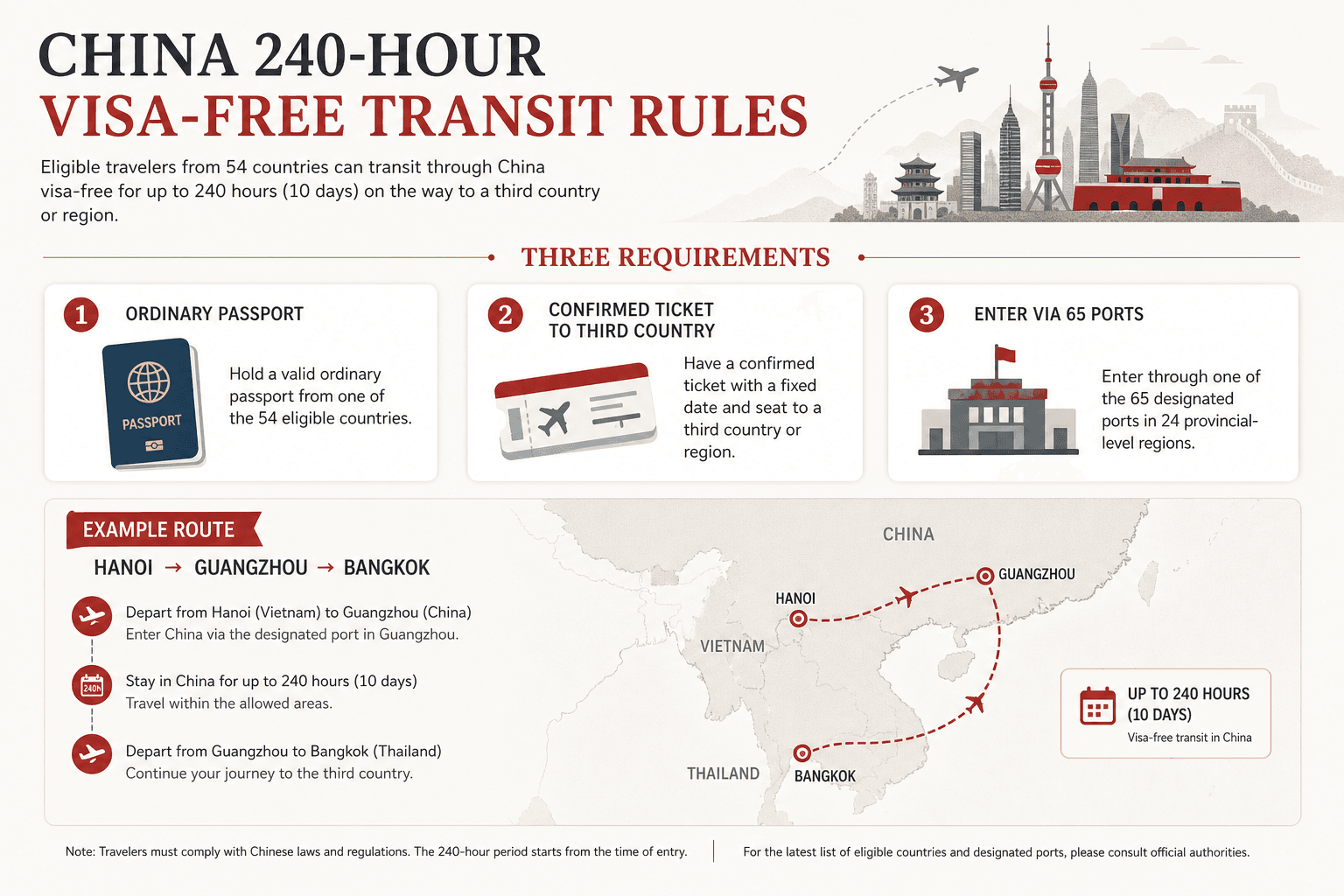
- 240-hour transit: eligible travelers may enter through any of China’s 65 open ports (including Beijing and Shanghai) and remain within designated areas for no more than 240 hours, with cross-provincial travel allowed under the existing transit rules.
- Hainan 30-day entry: the same nationals may enter Hainan Province only through its open ports and stay up to 30 days without a visa.
- Permitted activities: tourism, business, visits, and family reunions during the visa-free stay.
- Still excluded: work, study, and news reporting without an appropriate visa obtained before travel.
For the full policy hub and city-level port lists, start at our 240-hour visa-free transit guide and which cities allow 240-hour entry.
Core eligibility rules (all 57 countries)
The August announcement applies to Vietnam and Kyrgyzstan, but the mechanics are the same for every country on the 240-hour list. Immigration officers apply these at the port:
| Requirement | What officers look for |
|---|---|
| Passport | Valid ordinary passport (not a special-purpose document unless rules say otherwise). |
| Onward travel | Confirmed interline ticket with fixed dates and itinerary to a third country or region (not back to the country you departed from on the same simple round trip). |
| Entry port | Arrival through one of the 65 designated ports that accept 240-hour transit. |
| Stay clock | Maximum 240 hours from 00:00 on the day after entry (NIA standard calculation—confirm your stamp). |
| Geography | Stay within the 24 provinces/regions allowed under the transit policy; Hainan-only entry is a separate track (see below). |
Common rejection reason: a ticket that looks like a same-country round trip (for example Hanoi→Guangzhou→Hanoi only) instead of a genuine third-country onward segment. Build A→China→B before you fly.
After landing, complete immigration formalities including the China digital arrival card (if applicable to your category) and follow our airport entry guide.
The separate Hainan 30-day track
Vietnamese and Kyrgyz travelers now have two different visa-free tools. Do not mix them accidentally:

- 240-hour transit: mainland multi-city itineraries (Guangzhou + Shanghai + Xi’an, for example) if you meet the third-country ticket rule.
- Hainan 30-day: beach, Sanya, Haikou, and island-only tourism without automatically allowing travel to Guangzhou or Beijing on the same entry type.
If your goal is one island base with minimal paperwork, Hainan may be simpler. If you want high-speed rail across several provinces, plan under 240-hour transit with correct onward tickets.
Sample legal routes (illustrative)
These are routing examples, not guaranteed approvals. Airlines, schedules, and officer discretion vary.

Vietnam → mainland → Southeast Asia
- Hanoi or Ho Chi Minh City → Guangzhou (enter China).
- High-speed rail or domestic flights to Guilin, Shanghai, or Xi’an within the 240-hour window.
- Exit to a third country—for example Guangzhou or Shanghai → Bangkok, Kuala Lumpur, or Singapore.
Kyrgyzstan → mainland → Central or East Asia
- Bishkek → Urumqi or Beijing with a later confirmed ticket to a third country (Seoul, Dubai, or Bangkok are common routing hubs—verify availability).
- Use the transit window for Xinjiang or an eastern-city connection, staying inside allowed regions.
- Depart China before the 240-hour limit.
240-hour transit vs unilateral 30-day visa-free
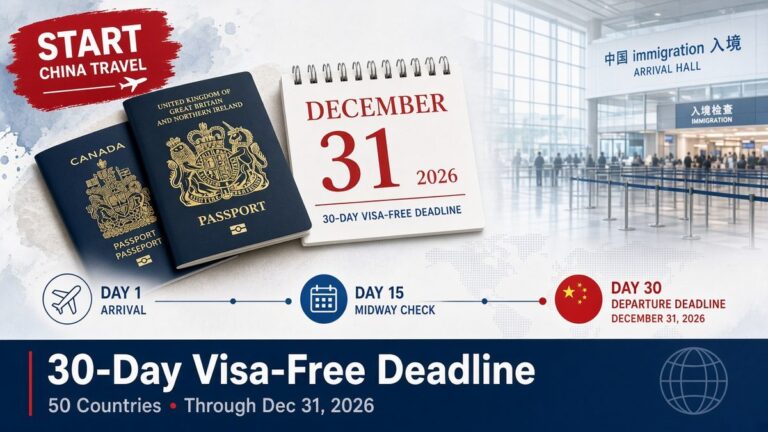
Vietnam is not on China’s separate 50-country unilateral 30-day visa-free list (that track covers nations such as France, Germany, Malaysia, and—since February 2026—the UK and Canada). Kyrgyzstan travelers should also check bilateral agreements separately.
For travelers who are on the 50-country list, compare options in our visa-free country list and visa-free planning guide.
Trip.com booking shortcuts
Lock onward third-country flights before you rely on 240-hour transit. For hotels and trains inside China, use English-language booking tools early—popular routes sell out around Chinese holidays.
Foreigner-friendly properties that accept international cards are easier to find through our hotel booking checklist.
FAQ
Can Vietnamese citizens enter China without any visa at all?
Yes, under the 240-hour transit or Hainan 30-day policies announced for Vietnam from 20 August 2026—if you meet passport, port, and onward-ticket rules. Other entry types still require visas.
Does 240-hour transit allow travel between provinces?
The current 240-hour policy allows movement within designated areas across allowed provinces. Confirm against the latest NIA port and region list before you book internal flights.
Is a same-day return to Vietnam allowed under 240-hour transit?
Transit visa-free status generally requires onward travel to a third country or region, not a simple round trip back to your origin. Officers may deny entry if the itinerary does not qualify.
Do I still need the digital arrival card?
Most foreign travelers—including visa-free entrants—should complete the digital arrival card unless you fall into a narrow exemption category listed by the NIA.