
Trip.com · Trains · 2026
Trip.com Estimated Chance of Securing Tickets (2026)
Trip.com does not publish an official success-rate table for train reservations. What you see in the app is inventory status and waitlist wording—not a guaranteed percentage. Plan around the 15-day release, peak demand, and auto-refund rules instead.
Trip.com estimated chance of securing tickets is a search phrase travelers use when pre-booking or waitlisting before China Railway inventory opens. There is no fixed percentage from Trip.com HQ—odds depend on route, date, and how early you book at release.
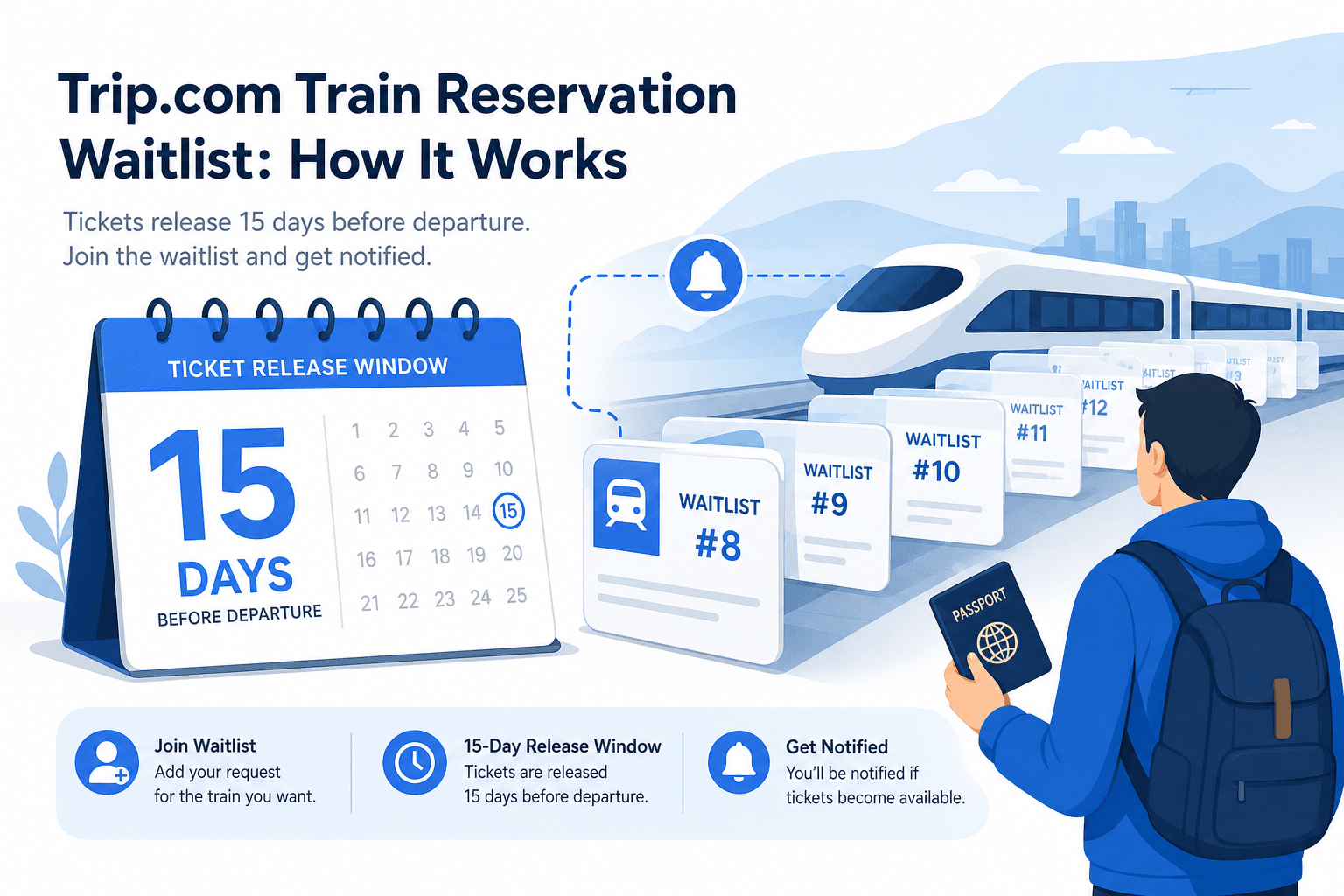
Book at release for the best odds. Use Trip.com waitlist/reservation when direct seats show sold out. Ignore third-party blogs that quote exact percentages—those are not Trip.com official figures.
The 15-day rule (same as 12306)
China rail inventory generally opens on a rolling window around 15 days before departure. Trip.com cannot confirm a standard ticket before inventory exists—so anything you do earlier is a reservation request, not a seat already issued.
Trip.com states the same core rule on its own content: in the How to Book China Train Tickets for Foreigners (2026) guide, it repeatedly tells travelers to book early and notes the 15-day window for peak seasons. The Peak Season guide also describes high-speed trains as usually released 15 days in advance (with occasional longer presales for specific routes).
Full walkthrough: How to book China trains on Trip.com.
Reservation, waitlist, and “estimated chance” UI
When seats are unavailable, Trip.com may offer a reservation or waitlist flow. Trip.com’s peak-season train guide explicitly mentions using waitlist booking (候补购票) in the official 12306 app or on Trip.com, and says the system can automatically match you to refunded or rescheduled tickets.
This is where people see optimistic wording (sometimes interpreted as an “estimated chance”). Treat it as inventory status + request validity, not a statistical guarantee.
- Pre-release orders: You pay or authorize payment; Trip.com attempts purchase when sales open—wording on your order screen is the source of truth.
- Sold-out routes: Trip.com’s peak-season guide suggests setting a long validity period (example given: until 20 minutes before departure) to improve matching chances—your actual validity window is shown in the booking flow.
- Cancellation service hours: Trip.com’s China train policy page says change/cancel requests should be submitted before departure during 08:00–20:00 (GMT+8). Source: Ticket change & cancellation policy.
Peak season reality: why nobody can promise odds
There is no single “chance” because demand changes by holiday and by route. Trip.com’s peak-season guide lists the busiest national periods as:
- Spring Festival (Chinese New Year): mid-January to late February (extended travel rush)
- National Day holiday (Golden Week): Oct 1–7
- May Day holiday: May 1–5
- Summer holiday: July 1 to Sept 1
Source: China Train Travel During Peak Season. If your date falls in these windows, treat any waitlist estimate as highly uncertain and build backups (different departure time, different day, or splitting into two segments).
Release times & refund peaks (actionable, source-backed)
Two levers matter more than any guessed percentage: when tickets first open and when tickets return.
- Release time varies by station: Trip.com’s peak-season guide says release times differ by station and suggests checking the 12306 app tool for “Release Time” (起售时间). It also shows example station times (e.g., Beijing West 08:00; Guangzhou South 10:15; Shanghai Hongqiao 13:45).
- Refund peaks: the same guide calls out heavy return windows around 24 hours before departure and additional releases close to departure (it mentions 4.5 hours before in some cases). Treat these as moments to re-check and refresh.
Practical expectations by scenario
| Scenario | What usually happens |
|---|---|
| Off-peak weekday, book at release | Direct purchase often completes if payment and passport details are correct. |
| Weekend Beijing–Shanghai / Chengdu–Chongqing | Competitive; book the minute inventory opens or use waitlist immediately. |
| Golden Week / Spring Festival | Hardest window; have backup dates, times, or connecting routes. |
| Already sold out everywhere | Waitlist on Trip.com or 12306 (Chinese UI) may still pick up returns—no channel promises a seat. |
The 6 most common reasons a “grab” fails
- Name mismatch: Passenger name must match passport exactly (spacing/order matter).
- Payment friction: Card blocked by bank, 3D Secure fails, or PayPal needs re-auth. Fix: call your bank once and retry.
- Too narrow request: One specific train only. Better: allow multiple trains / times if your plans permit (Trip.com and 12306 both recommend flexibility during peak periods).
- Short validity window: Standby ends too early. Trip.com’s peak-season guide suggests a longer validity (example: until 20 minutes before departure) when available.
- Group size: Two or more seats together is harder than one seat. Family seating is never guaranteed; see family seats FAQ.
- Last-minute constraints: Some online cancel/change actions have service-hour limits (Trip.com policy page: 08:00–20:00 GMT+8) and last-minute windows where actions may be blocked.
If Trip.com cannot secure the ticket
Failed reservation attempts typically trigger a refund to the original payment method; posting time depends on the bank and the policy route. Trip.com’s 2026 booking guide mentions a refund window of 7–15 working days for certain Trip.com refund flows, while other Trip.com policy pages for trains can show different ranges—always read the refund line inside your order details. Source: Trip.com 2026 booking guide.
Payment never completed? See payment failed. Refund stuck beyond your order’s stated window? Use our conservative escalation checklist: refund delay guide.
Trip.com China trains- Does Trip.com show an estimated chance of securing tickets?
- Some flows may show reservation or waitlist status text. Trip.com does not publish a verified success-rate table in its help center.
- Is 99% or 60% success real?
- Percentages on third-party blogs are anecdotal estimates, not Trip.com official data. Do not plan around them.
- How far ahead can I reserve?
- Pre-sale reservation windows vary by product wording on Trip.com; confirmed tickets still tie to China Railway’s release schedule. Read your checkout screen.
- Do I get refunded if the grab fails?
- Policy pages describe automatic refund paths for failed reservations—confirm on your order confirmation email.
- What time window can I cancel online?
- Trip.com’s policy page says submit change/cancel requests before departure during 08:00–20:00 (GMT+8). See ticket change & cancellation policy.
Trip.com links on this page are partner links. See site Affiliate disclosure.